


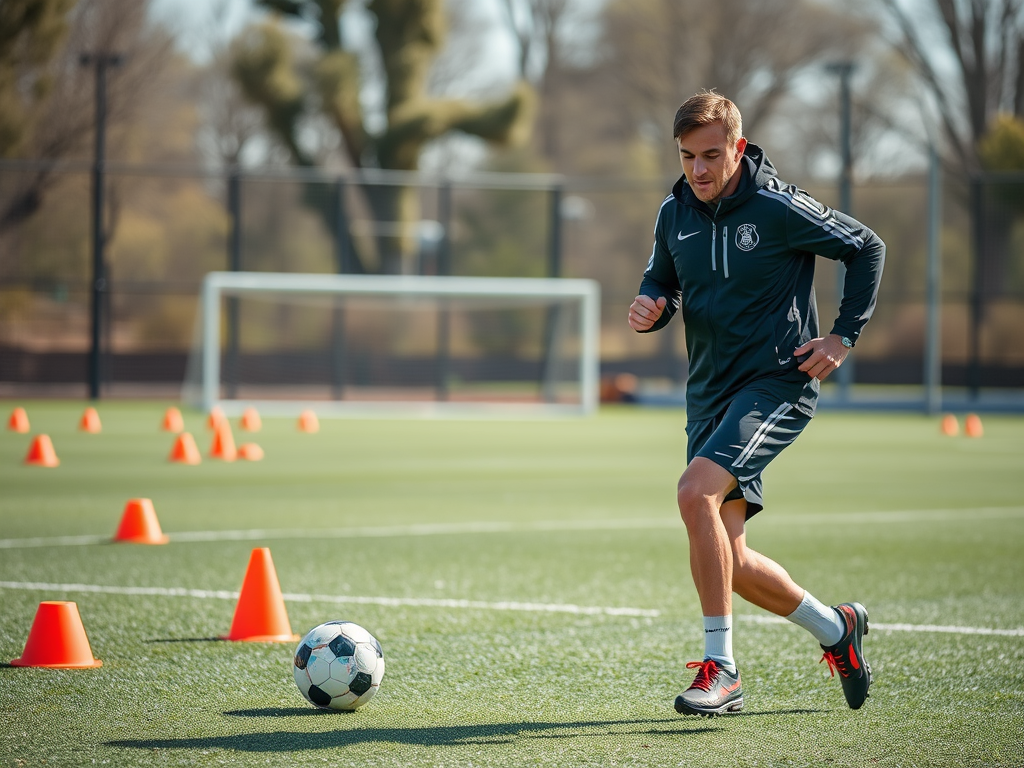
When Coach Nicholas Serenati talks about the top 5 speed & agility truths thta most programs get wrong, he is outlining conditions that are not benefiting the player as a whole.
Let’s be honest: most “speed training” looks good on Instagram and does absolutely nothing on Saturday. If it doesn’t transfer to game moments—pressure, chaos, decisions—it’s noise. Below are the five truths that separate real performance from conditioning theater.

1. Speed Without Decision-Making Is Fake Speed
If a player only looks fast in straight lines, they’re not fast—they’re rehearsed.
Game speed is perception → decision → action. The fastest players aren’t just moving quickly; they’re choosing earlier. Training that ignores scanning, cues, and choices creates athletes who win races in warm-ups and lose duels in matches.
Bottom line:
If there’s no decision, it’s not speed—it’s cardio with spikes.
2. Agility Is Not Ladder Work
Agility is reaction to stimulus, not memorized foot patterns.
Ladders can help coordination early on, but once they dominate a program, progress stalls. Real agility demands an external cue—an opponent’s movement, a visual signal, a ball flight, a space that suddenly closes.
Bottom line:
If the athlete already knows the pattern, you’re training choreography—not agility.
3. Strength Is the Governor of Speed
You don’t sprint with effort. You sprint with force.
Weak athletes leak force at ground contact. That means slower acceleration, poorer deceleration, and higher injury risk. Proper strength training doesn’t make players bulky—it gives them the capacity to express speed safely.
Bottom line:
Speed is rented. Strength owns the building.
4. Most “Speed Training” Ignores Braking
Everyone loves acceleration. Very few train stopping.
Yet soccer is a game of violent decelerations: pressing, cutting, recovering, changing direction under pressure. Players who can’t brake efficiently lose balance, lose time, and lose duels.
Bottom line:
If a player can’t stop well, they can’t move well.
5. Early Speed Peaks Are a Trap
Early developers win games at 9, 10, 11… then disappear.
Why? Because speed masked poor movement quality, poor positioning, and poor decision-making. When the field gets bigger and opponents get smarter, raw speed alone stops working.
Bottom line:
The goal isn’t to be the fastest kid now—it’s to be fast when it matters later.
What This Means for Parents and Players
If a program promises speed without teaching:
- movement efficiency
- strength foundations
- deceleration mechanics
- decision-making under pressure
…it’s incomplete.
True speed development is earned, not advertised.
Nicholas Serenati, Ph.D. | Elite Youth Soccer Coach & Sports Performance Specialist
Nicholas Serenati, Ph.D. is an elite youth soccer coach, sports performance specialist, and player development authority, and the founder and head academy coach of Royal United Football Club (RUFC) — an independent high-performance soccer academy dedicated to long-term player development.
A former NCAA Division I soccer player at Mount St. Mary’s University, Coach Serenati has vast soccer coaching experience and holds strength and conditioning and sports performance certifications, bringing a rare integration of technical expertise, tactical intelligence, and applied sports science into modern youth development environments.
With a Ph.D. in Interdisciplinary Studies and more than a decade of experience as a professor and program leader in higher education, Dr. Serenati bridges the worlds of academics and athletics, grounding his coaching methodology in evidence-based training, cognitive development, and whole-player performance systems.
His areas of specialization include:
• Youth soccer development• Technical mastery and tactical intelligence (soccer IQ)• Strength and conditioning for soccer players• Speed and agility training• Sports performance and injury resilience• Cognitive speed and decision-making• Small group and 1v1 soccer training• Long-term athlete development pathways
Under his leadership, Royal United FC has evolved into a premier independent soccer academy recognized for its rigorous training environment, hybrid European development model, and individualized player development pathways designed to prepare student-athletes for high-performance environments.
Dr. Serenati publishes research-driven insights on youth soccer development, elite training methodology, strength and conditioning, tactical intelligence, and sports performance systems across his digital platforms:
• Official Site: https://coachnicholasserenati.com
• Academy Platform: https://royalunitedfc.com
• Substack Publication: https://nicholasserenati.substack.com
His mission is clear: to develop intelligent, technical, resilient footballers — and even greater people — through evidence-based coaching and long-term player development.
You must be logged in to post a comment.