


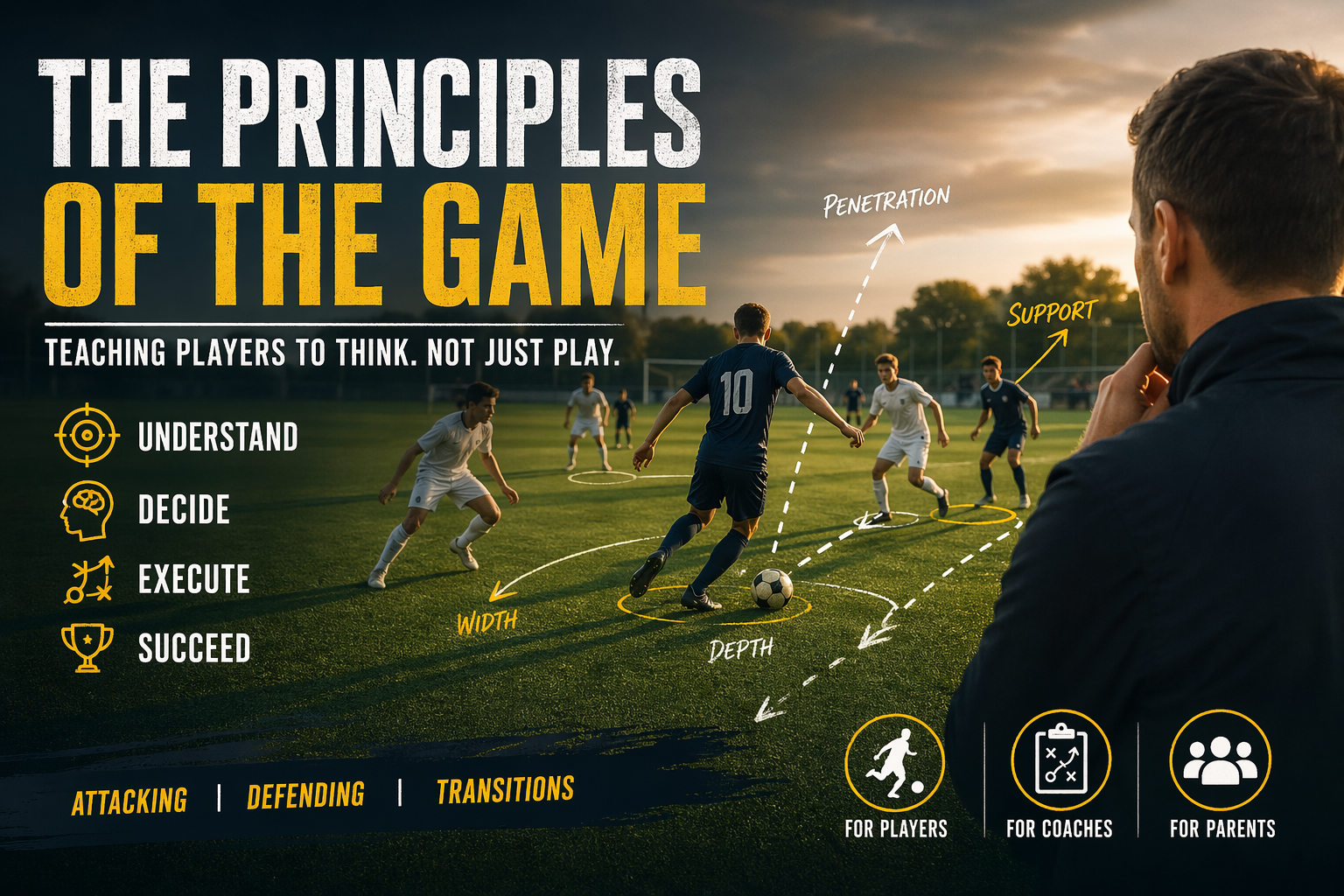
Introduction: The Missing Language of Development
Watch a typical youth match and you’ll hear:
- “Spread out!”
- “Pass it!”
- “Shoot!”
All commands. No context. No framework.
What’s missing is why—the underlying structure that guides decisions. That structure is what we call the Principles of the Game.
These principles are not tactics, formations, or drills.
They are the universal laws of football behavior—the reference points that govern how players interpret and act within the game.
If we’re serious about developing intelligent players—thinking players—this is where coaching must begin.
Defining the Principles of the Game
At the highest level, the game can be broken into four moments:
- Attacking (in possession)
- Defending (out of possession)
- Transition to Attack (winning the ball)
- Transition to Defense (losing the ball)
Within each moment, there are principles—guiding ideas that shape player behavior.
Attacking Principles
- Penetration
- Support
- Width
- Depth
- Mobility
- Improvisation
Defending Principles
- Delay
- Cover
- Balance
- Compactness
- Control/Restraint
Transitional Principles
- Immediate reaction
- Exploitation of disorganization
- Reorganization
These are not theoretical—they are visible in every elite environment, from academies to clubs like FC Barcelona, Manchester City, and Bayern Munich.
The difference? At that level, players understand them—and act accordingly.
Why Principles Matter (For Players, Coaches, and Parents)
For Players
Principles provide:
- A decision-making framework
- Faster processing under pressure
- Adaptability across systems and positions
Instead of memorizing patterns, players learn to read situations.
For Coaches
Principles shift coaching from:
- Drill-based → Game-based
- Command-based → Guided discovery
They allow you to design sessions that actually transfer to the match.
For Parents
Understanding principles changes expectations:
- Development becomes about decision-making, not just goals scored
- Mistakes become learning moments, not failures
Deep Dive: The Principle of Penetration
Let’s focus on one principle and teach it properly.
Definition
Penetration is the ability to break lines and move the ball or player closer to the opponent’s goal.
It is the primary attacking intention.
No penetration = no threat.
What Penetration Looks Like (In Reality)


7
Penetration can occur through:
1. Passing
- Line-breaking passes
- Through balls
- Split passes between defenders
2. Dribbling
- 1v1 attacking actions
- Driving into space
- Eliminating defenders
3. Movement
- Runs in behind
- Third-man runs
- Positional rotations
The Decision Hierarchy of Penetration
Here’s where most coaching falls apart—we don’t teach when to penetrate.
Elite players operate on a simple internal hierarchy:
- Can I go forward? (Penetrate)
- If not → Can I create penetration? (Support/movement)
- If not → Can we reset to create a better moment?
This is what players like Kevin De Bruyne or Luka Modrić do instinctively.
It’s not magic—it’s trained perception.
Want your player to actually understand the game—not just play it?
Explore Royal United FC training programs built on these exact principles.
Common Youth Mistakes Around Penetration
Let’s be direct:
1. Forcing It
Players try to penetrate when it’s not on → turnovers.
2. Avoiding It
Players play safe sideways passes → no threat.
3. Misreading Space
Players don’t recognize:
- Defensive gaps
- Timing of runs
- Pressure cues
These are not technical issues.
They are perceptual and cognitive failures.
How to Train Penetration (The Right Way)
Forget isolated drills. They don’t teach decision-making.
Instead, design constraints-led environments:
1. Directional Small-Sided Games
- Reward forward passes
- Limit backward options
2. Zone-Based Games
- Create channels for line-breaking actions
- Encourage vertical play
3. Transition Games
- Emphasize immediate forward action after winning the ball
This aligns directly with modern methodologies rooted in ecological dynamics and representative learning design.
Coaching Language That Builds Understanding
Replace commands with questions:
- “Where is the space to go forward?”
- “What did you see before receiving?”
- “Why was penetration possible there?”
This builds Soccer IQ, not just compliance.
Bridging Principles to Your Game Model
Principles are universal.
Your game model is how you express them.
For example:
- A possession-based model (like FC Barcelona) may emphasize patient penetration
- A transition model (like Liverpool FC) may emphasize rapid penetration
Same principle. Different expression.
Final Thought: This Is the Real Work
If you want better players:
- Stop teaching them what to do
- Start teaching them how to decide
The principles of the game are not optional.
They are the foundation of everything.
And if we get this right, we don’t just develop better players—
We develop players who understand the game at a level most never reach.
FAQ
What are the principles of the game in soccer?
The principles of the game are the fundamental concepts that guide player behavior in attacking, defending, and transitions.
Why are principles of play important in soccer?
They improve decision-making, speed of play, and tactical understanding, allowing players to adapt to any game situation.
How do you teach principles of play in soccer?
Through small-sided games, constraints-led training, and guided questioning rather than isolated drills.
What is the most important attacking principle?
Penetration—the ability to break lines and move toward goal—is the primary attacking objective.
Resources:
Nicholas Serenati, Ph.D. | Elite Youth Soccer Coach & Sports Performance Specialist
Nicholas Serenati, Ph.D. is an elite youth soccer coach, sports performance specialist, and player development authority, and the founder and head academy coach of Royal United Football Club (RUFC) — an independent high-performance soccer academy dedicated to long-term player development.
A former NCAA Division I soccer player at Mount St. Mary’s University, Coach Serenati has vast soccer coaching experience and holds strength and conditioning and sports performance certifications, bringing a rare integration of technical expertise, tactical intelligence, and applied sports science into modern youth development environments.
With a Ph.D. in Interdisciplinary Studies and more than a decade of experience as a professor and program leader in higher education, Dr. Serenati bridges the worlds of academics and athletics, grounding his coaching methodology in evidence-based training, cognitive development, and whole-player performance systems.
His areas of specialization include:
• Youth soccer development• Technical mastery and tactical intelligence (soccer IQ)• Strength and conditioning for soccer players• Speed and agility training• Sports performance and injury resilience• Cognitive speed and decision-making• Small group and 1v1 soccer training• Long-term athlete development pathways
Under his leadership, Royal United FC has evolved into a premier independent soccer academy recognized for its rigorous training environment, hybrid European development model, and individualized player development pathways designed to prepare student-athletes for high-performance environments.
Dr. Serenati publishes research-driven insights on youth soccer development, elite training methodology, strength and conditioning, tactical intelligence, and sports performance systems across his digital platforms:
• Official Site: Coach Nicholas Serenati
• Academy Platform: Royal United FC
• Substack Publication:
Coach Nicholas Serenati’s Substack
A Coach’s Notepad: Thoughts, Questions, and Explanations
His mission is clear: to develop intelligent, technical, resilient footballers — and even greater people — through evidence-based coaching and long-term player development.
Leave a Reply