


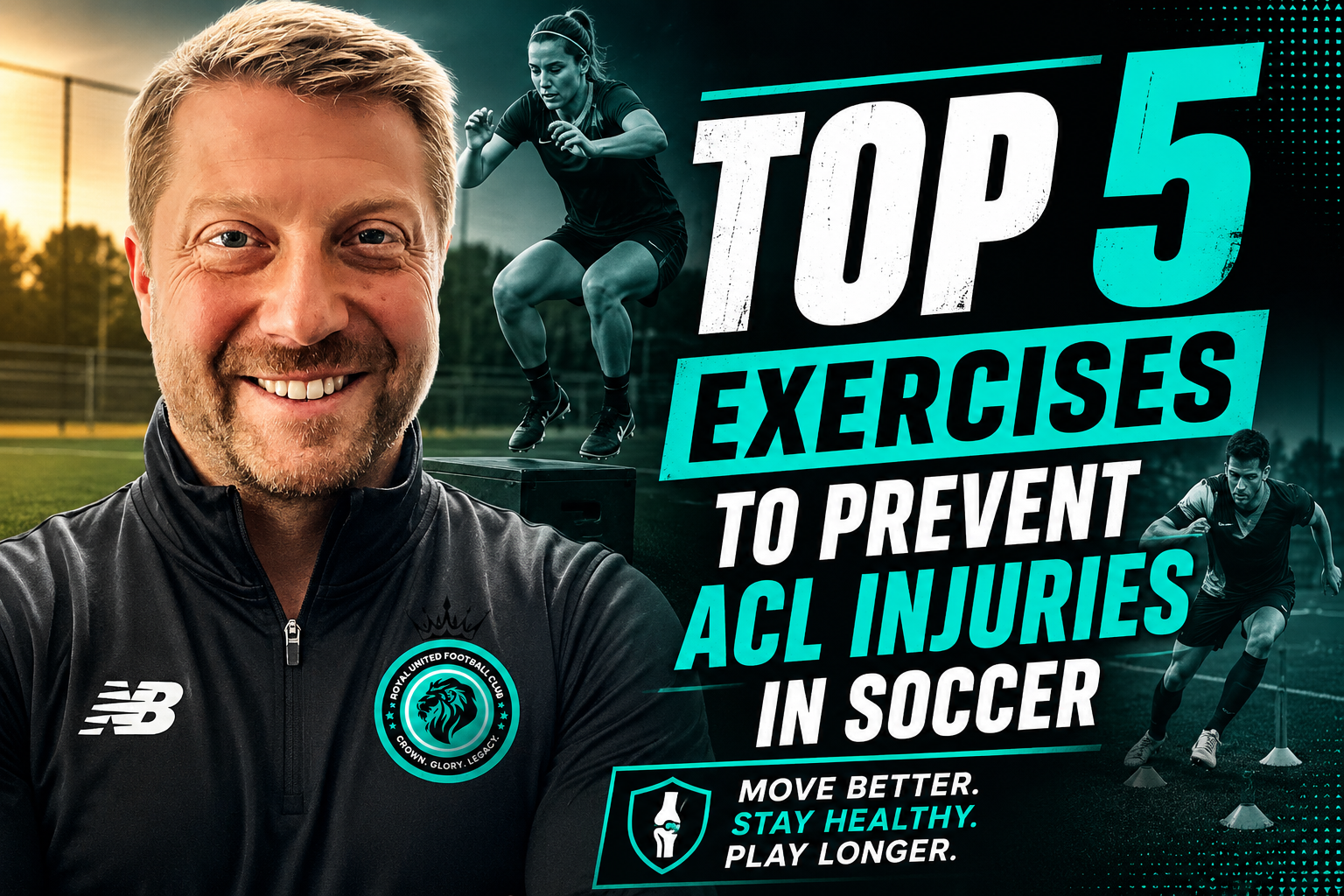
What are the top 5 exercises to prevent ACL injuries in soccer?
Coach Nicholas Serenati believes soccer players need more than technical skill to stay healthy and perform at a high level. The modern game demands explosive acceleration, rapid cutting, single-leg stability, controlled landing mechanics, and efficient deceleration. That is why these top 5 exercises to prevent ACL injuries in soccer should be part of every serious player development program. When trained consistently, ACL prevention exercises can help soccer players improve strength, movement quality, body control, and long-term athletic durability.
The reality is uncomfortable but important:
Most ACL injuries in soccer are not caused by contact.
They happen during:
- sudden deceleration,
- planting and cutting,
- awkward landings,
- rotational instability,
- and poor movement mechanics under fatigue.
That means injury prevention is not simply about “getting stronger.” It is about teaching the body to move efficiently, absorb force correctly, and remain stable under pressure.
The best injury prevention programs in the world now focus on:
- neuromuscular control,
- eccentric strength,
- landing mechanics,
- deceleration,
- and single-leg stability.
Below are five of the most effective exercises that soccer players should consistently incorporate into their training if they want to reduce injury risk and improve long-term athletic durability.
1. Nordic Hamstring Curl
The Gold Standard for Posterior Chain Protection (Top 5 Exercises to Prevent ACL Injuries in Soccer)
If there is one exercise nearly every high-performance soccer environment prioritizes, it is the Nordic Hamstring Curl.

Why It Matters
The hamstrings play a major role in stabilizing the knee joint. During sprinting, stopping, and landing, they help counteract the forward pull placed on the tibia by the quadriceps — a mechanism heavily associated with ACL stress.
Weak hamstrings create instability. Strong eccentric hamstrings create protection.
This exercise develops:
- eccentric hamstring strength,
- sprint resilience,
- deceleration capacity,
- and lower-body force control.
Research has consistently shown that Nordic Hamstring training significantly reduces lower-extremity injury risk in soccer populations.
How to Perform It

- Kneel with ankles secured by a partner or anchor.
- Keep hips extended and torso tall.
- Slowly lower yourself forward under control.
- Catch yourself with your hands as late as possible.
- Push lightly off the ground and return.
The Nordic Hamstring Curl is one of the most researched and effective exercises in soccer injury prevention. It strengthens the hamstrings eccentrically — the exact type of strength players need during sprinting, stopping, and decelerating.
Strong hamstrings help stabilize the knee joint and reduce excessive stress placed on the ACL during explosive movement patterns.
Key Benefits
- Improves eccentric hamstring strength
- Enhances sprint durability
- Improves deceleration control
- Reduces lower-body injury risk
Coaching Emphasis
Control the lowering phase. The slower the athlete can resist gravity, the more protective value the exercise provides.
The goal is not speed. The goal is controlled resistance.
Soccer players must learn to absorb force before they learn to produce it explosively.
2. Copenhagen Adduction Exercise
The Most Underrated Injury Prevention Exercise in Soccer (Top 5 Exercises to Prevent ACL Injuries in Soccer)

Most coaches think ACL prevention only involves the knees.
Elite programs know the hips and groin are equally important.
The Copenhagen Adduction Exercise strengthens the adductors — the muscles responsible for stabilizing lateral movement, directional changes, and pelvic control.
Why It Matters

During cutting and deceleration, weak adductors can contribute to:
- knee collapse,
- pelvic instability,
- poor cutting mechanics,
- and uncontrolled lateral movement.
This exercise is particularly important in soccer because the sport constantly demands:
- lateral acceleration,
- rotational control,
- and unilateral stabilization.
How to Perform It

- Place the top leg on a bench or elevated surface.
- Support the body with the lower forearm.
- Lift hips off the ground while maintaining alignment.
- Hold or perform controlled repetitions.
The Copenhagen Exercise targets the adductors and groin complex — critical muscles for lateral movement, cutting, and pelvic stabilization.
In soccer, players constantly shift direction under speed and pressure. Weak adductors often contribute to instability that can eventually cascade down to the knee joint.
Key Benefits
- Improves pelvic stability
- Enhances lateral force control
- Reduces groin injury risk
- Supports cutting mechanics
Coaching Emphasis
The body should remain aligned from shoulder to ankle. Avoid sagging hips or rotational compensation.
Stability is athleticism.
Players who cannot control their body laterally will eventually struggle to control force rotationally.
3. Single-Leg Hop and Stick
Teaching the Body How to Land (Top 5 Exercises to Prevent ACL Injuries in Soccer)

One of the biggest predictors of ACL injury risk is poor landing mechanics.
Soccer players frequently land on one leg after:
- headers,
- tackles,
- directional changes,
- and reactive movements.
The issue is not jumping.
The issue is how players absorb force when they return to the ground.
Why It Matters
This exercise trains:
- balance,
- knee alignment,
- proprioception,
- deceleration mechanics,
- and force absorption.
It also teaches players how to stabilize dynamically rather than statically — which is critical in soccer.

How to Perform It
- Hop forward, laterally, or diagonally on one leg.
- Land softly and stabilize immediately.
- Hold the position for 2–3 seconds.
- Prevent the knee from collapsing inward.
Most non-contact ACL injuries occur during uncontrolled landings, cuts, or deceleration moments.
The Single-Leg Hop and Stick teaches athletes how to:
- stabilize dynamically,
- control knee alignment,
- and absorb force efficiently through the hips and trunk.
Key Benefits
- Improves landing mechanics
- Enhances proprioception and balance
- Reduces knee valgus collapse
- Builds reactive stability

Coaching Emphasis
Land softly and stabilize completely before moving again. Players should “own” the landing position.
Quiet landings are controlled landings.
The athlete should “own” the position before moving again.
4. Single-Leg Romanian Deadlift (RDL)
Building Athletic Stability from the Ground Up (Top 5 Exercises to Prevent ACL Injuries in Soccer)

Soccer is a unilateral sport.
Players sprint, cut, plant, and strike primarily off one leg at a time. Yet many athletes train almost entirely bilaterally.
The Single-Leg RDL develops:
- posterior-chain strength,
- balance,
- hip stability,
- and movement coordination.
Why It Matters
Many ACL injuries begin higher up the chain at the hip and pelvis.
Poor hip control often creates:
- knee valgus,
- unstable planting,
- and inefficient force transfer.
The Single-Leg RDL teaches athletes to stabilize through the hip while maintaining posture and control.

How to Perform It
- Balance on one leg.
- Hinge at the hips while extending the opposite leg backward.
- Keep spine neutral.
- Return to standing under control.
Soccer is played one leg at a time.
The Single-Leg RDL develops the posterior chain while simultaneously improving balance, coordination, and hip stability — all crucial components in injury prevention.
Poor hip control frequently contributes to knee instability during planting and directional changes.
Key Benefits
- Improves hip stability
- Enhances posterior-chain strength
- Develops single-leg control
- Reduces movement asymmetries
Coaching Emphasis
This exercise is about stability and body control, not simply touching the floor with the hand.
This is not a flexibility drill.
It is a stability and force-management exercise disguised as strength work.
5. Deceleration Sprint Stops
The Missing Piece in Most Soccer Training (Top 5 Exercises to Prevent ACL Injuries in Soccer)

Most youth players spend hours learning how to accelerate.
Very few are taught how to stop.
That is a problem.
Many ACL injuries occur during uncontrolled deceleration — particularly when athletes attempt to change direction at high speed without proper body positioning.
Why It Matters
Deceleration training teaches athletes to:
- lower their center of gravity,
- absorb force through the hips,
- widen their base of support,
- and control momentum efficiently.
This exercise directly addresses the chaotic movement demands of soccer.

How to Perform It
- Sprint forward for 10–15 yards.
- Decelerate aggressively into a controlled athletic stance.
- Maintain chest position and knee alignment.
- Avoid upright braking.

Many players are taught how to sprint.
Very few are taught how to stop.
Yet most ACL injuries occur during uncontrolled deceleration or rapid change-of-direction actions.
Teaching athletes how to lower their center of gravity, widen their base, and absorb force through the hips is essential in modern soccer development.
Key Benefits
- Improves braking mechanics
- Enhances change-of-direction control
- Reduces knee stress during cutting
- Builds athletic movement efficiency
Coaching Emphasis
Great athletes are not simply explosive — they are controlled under chaos.
Elite movement is not just about speed.
It is about the ability to control speed.
The best athletes in the world are often the best decelerators.
Final Thought
Injury Prevention Is Performance Training
The best injury prevention systems in soccer are not built around fear.
They are built around movement quality.
The same exercises that help reduce ACL injury risk also improve:
- acceleration,
- balance,
- body control,
- agility,
- and overall athletic efficiency.
Modern player development is no longer just about technical ability.
It is about building athletes who can move intelligently, stabilize under pressure, and remain durable throughout the demands of the game.
Because the best players in the world are not just talented.
They are available.
Frequently Asked Questions About ACL Injury Prevention in Soccer
What is the ACL and why is it important in soccer?
The ACL, or anterior cruciate ligament, is one of the primary stabilizing ligaments in the knee. It helps control rotational movement and prevents excessive forward movement of the tibia.
In soccer, the ACL is heavily stressed during cutting, planting, decelerating, landing, and rapid directional changes. Because the game is so dynamic and reactive, the ACL plays a major role in maintaining knee stability under high-speed movement conditions.
Are most ACL injuries in soccer caused by contact?
No. Most ACL injuries in soccer are non-contact injuries.
They typically occur during awkward landings, sudden deceleration, uncontrolled cuts, or rotational instability. This is why movement quality, strength, and neuromuscular control are so important in injury prevention training.
At what age should players begin ACL injury prevention training?
Players can begin age-appropriate injury prevention training as early as 7 to 9 years old.
For younger athletes, the focus should be on balance, coordination, landing mechanics, movement literacy, and body awareness. As players mature, programs can progressively include strength training, plyometrics, eccentric loading, and advanced deceleration mechanics.
How often should soccer players perform ACL prevention exercises?
Ideally, soccer players should perform ACL prevention work 2 to 3 times per week.
Even short 10 to 15 minute sessions incorporated into warm-ups can significantly improve movement quality and reduce injury risk over time. Consistency matters far more than excessive volume.
Are ACL injuries more common in female soccer players?
Yes. Research consistently shows that female athletes experience ACL injuries at higher rates than male athletes in sports like soccer and basketball.
Several contributing factors may include biomechanical differences, hormonal influences, landing mechanics, hip strength, and neuromuscular control patterns. However, proper training and prevention strategies can dramatically reduce risk.
Can strength training help prevent ACL injuries?
Absolutely. Properly designed strength training improves force absorption, joint stability, muscular balance, and movement control.
Particularly important areas include the hamstrings, glutes, adductors, calves, and core stability. The goal is not simply building muscle; it is improving movement efficiency and resilience.
Why is deceleration training important for soccer players?
Many ACL injuries occur when athletes cannot properly control momentum while stopping or changing direction.
Deceleration training teaches players how to lower their center of gravity, stabilize the trunk, absorb force through the hips, and control knee positioning. Elite movement is not just about acceleration. It is about braking efficiently under pressure.
What are the warning signs of poor movement mechanics?
Common red flags include knees collapsing inward during landing, loud or stiff landings, poor balance on one leg, excessive trunk sway, upright deceleration posture, and instability during cuts or directional changes.
These movement patterns should be corrected early before they become injury risks.
Does stretching prevent ACL injuries?
Stretching alone does very little to prevent ACL injuries.
While mobility is important, ACL prevention requires strength, stability, neuromuscular control, balance, and proper movement mechanics. Dynamic preparation and structured neuromuscular training are far more effective than passive stretching alone.
What is the FIFA 11+ program?
The FIFA 11+ is one of the most researched soccer-specific injury prevention warm-up systems in the world.
It combines running mechanics, strength, balance, plyometrics, and movement control exercises. Research has shown significant reductions in overall soccer injury rates when teams consistently implement the program.
Can ACL prevention training improve performance too?
Yes. This is one of the biggest misconceptions in youth sports.
The same qualities that reduce injury risk also improve acceleration, agility, balance, change-of-direction ability, body control, and athletic efficiency. Injury prevention and athletic performance are deeply connected.
What is the biggest mistake coaches make with injury prevention?
The biggest mistake is inconsistency.
Many teams perform prevention work for one or two weeks and then abandon it once the season becomes busy. The most effective injury prevention systems are structured, progressive, intentional, and consistently applied throughout the year.
Durability is developed the same way technical skill is developed: through repetition and disciplined training habits.
FIFA 11+ injury prevention program
National Institutes of Health ACL injury prevention research
British Journal of Sports Medicine ACL prevention studies
PubMed research on Nordic hamstring curl injury prevention
PubMed research on Copenhagen adduction exercise
Check out our other articles on building the best performing soccer player:
The Moment Before the Ball Arrives
Ready to train smarter, move better, and build a stronger soccer player? Learn more about Royal United FC training programs in St. Augustine and World Golf Village at Royal United FC.
You must be logged in to post a comment.